Posts

Showing posts with the label Allied Bombing Offensive

Masters of Precision - The Mossies

Image
  617 Squadron was by no means the only RAF unit engaged in precision bombing. The Mosquito bombers likewise proved to be extremely accurate when in capable hands -- far ahead of anything the USAAF ever delivered. Two examples of their outstanding accuracy will serve to prove the case.    As the war progressed, the French Resistance grew increasingly strong and effective. In anticipation of the Allied landing on the Continent, the French Resistance played an increasingly vital role in both providing intelligence and sabotaging German installations. By late 1943, however, many French Resistance cells had been infiltrated by German spies and in the winter of '43/'44 the Germans struck with mass arrests. On 14 Februrary 1944, a Resistance leader who literally "knew too much" about the Allied invasion plans was arrested by the Gestapo and put in Amiens Gestapo prison. He was not alone. Four American spies, three British agents, a Belgian spy, and over 800 othe...
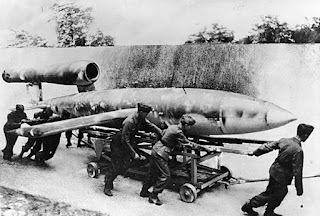
Attacking Hitler's "Wunderwaffen" (V1, V2, V3)

Image
Hitler's Wonder or Vengeance Weapons ( Wunderwaffen or Vergeltungswaffen ) killed roughly 9,000 civilians in the UK and damaged half the housing in the British capital. The V1 was the first "cruise missile" and the V2 was the first rocket-delivered explosives in history. While few believe they alone could have altered the outcome of the war, the damage they inflicted called for a vigorous response. Yet the RAF's options against these new weapons were limited.   Just one week after D-Day, the first of Hitler's Vengeance weapons struck British soil. They instantly killed 6, injured 30 and made 200 people homeless in a single unopposed attack that risked not a single German life. Three days later, V1s had taken 499 lives and injured 2,000 while 137,000 buildings had been damaged. The V1 was a drone, or a flying bomb as it was called at the time, roughly the same size as contemporary fighters, but unmanned. They were also very crudely controlled. Essentially, they wer...

617's Most Influential CO: Leonard Cheshire

Image
  No one is more closely associated with 617 Squadron then Wing Commander Guy Gibson. He formed the squadron, hand-picking many of the pilots. He led it to fame on the Dams Raid. Yet he literally only flew on one operation with the squadron, and his command ended after less than three months. No other wartime CO was on the squadron for a shorter period. The CO who commanded the squadron longest -- albeit, even then, only eight months -- was also the man who gave it a mission. Thus even if his name is not so immediately associated with 617, he was in fact more influential than any of the five men who led the squadron in WWII.    Cheshire, who by September 1943 already had a distinguished war record and was the youngest Group Captain in the RAF recruited to command 617 Squadron in order to help solve a pressing problem. With their backs increasingly to the wall, the Germans had unleashed their creativity to develop four devilishly advanced and potentially game-changing ...

The Killer Canal

Image
  617 Squadron took on the toughest targets -- the Ruhr Dams, the battleship Tirpitz, U-boat pens, the V1 and V2 launch sites -- yet in two years of operation only one target killed the squadron's CO. It might just have been bad luck, of course, but on 15 September 1943 an attack on this target resulted in the loss of six of the nine aircraft sent against it. At 62%, this represented the highest percentage loss of any 617 operation.  It was the Dortmund-Ems Canal.   The Dortmund-Ems Canal -- what the Germans call the Mittelland Kanal -- was a 160-mile-long  infrastructure link between the ports of the Baltic and North Seas and the industrial heart of German. The barges that traveled sedately upon its waters carried enormous quantities of coal and iron ore from the East, including from Poland and Sweden, to the steel plants and foundries of the Ruhr. It also transported finished arms and ammunition to the Eastern Front and prefabricated parts for U-boats being assembl...

The Dambusters

Image
Despite routinely being accused of doing only "area bombing" one of the most precise -- and arguably the most effective RAF raid of WWII -- was the RAF attack of 16/17 May 1943 on the Ruhr Dams. The raid was immortalized in the post-war film "The Dam Busters."   It all started with Barnes Wallis, an innovative engineer. At the outbreak of the war, Wallis was already 52 and recognized as one of the leading aircraft designers of his generation, but he found himself wondering what he -- as an engineer -- could do to shorten a war that he knew would be horrible. Freed from work on any specific project, he started to experiment with a variety of ideas. No longer tied to government specifications, his imagination took flight, and while many of his ideas were dismissed by contemporaries as impractical if not ridiculous, Wallis' philosophy was to see criticism as a stimulus to keep perfecting an idea. (Below Barnes Wallis) He also spent time studying the industrial ...